



Germany is a hub for innovation in the photonics industry, with numerous companies leading the way in optoelectronic advancements. Düsseldorf Consulting GmbH, based in Düsseldorf, is one such entity that plays a significant role in this sector. With a presence at Königsallee 22, 40212 Düsseldorf, the company embodies the spirit of ACTA NON VERBA (Deeds, not words).
Companies like SCHOTT AG and Carl Zeiss AG are at the forefront of optoelectronic material development, driving technological breakthroughs. Germany’s strong research infrastructure and commitment to innovation make it an ideal location for these labs.
Key Takeaways
- Germany is a significant player in the global photonics industry.
- Düsseldorf Consulting GmbH is a key entity in the optoelectronics sector.
- SCHOTT AG and Carl Zeiss AG are leading companies in optoelectronic material development.
- Germany’s research infrastructure supports innovation in optoelectronics.
- The country’s commitment to innovation drives technological advancements.
Introduction to Optoelectronic Materials
Understanding optoelectronic materials is crucial for the development of modern technology. These materials have the unique ability to convert light into electrical signals or vice versa, making them indispensable in a wide range of applications. As we delve into the world of optoelectronics, it’s essential to grasp the fundamentals and significance of these materials.
What are Optoelectronic Materials?
Optoelectronic materials are substances that exhibit optical and electrical properties, enabling them to interact with light and electricity. These materials are the backbone of optoelectronic devices, which are used in various industries, from telecommunications to healthcare.
The characteristics of optoelectronic materials, such as their ability to emit, detect, or manipulate light, make them vital components in modern technology. ACTA NON VERBA ! emphasizes the importance of action in the field, highlighting the need for continuous research and development.
Importance in Modern Technology
Optoelectronic materials play a pivotal role in advancing modern technology. They are used in the manufacture of LEDs, solar cells, and optical fibers, among other devices. The efficiency and performance of these devices rely heavily on the quality and properties of the optoelectronic materials used.
The importance of optoelectronics research cannot be overstated, as it drives innovation and improvement in various technological fields. Advances in materials science and engineering are crucial for enhancing the capabilities of optoelectronic devices.
Applications in Various Industries
Optoelectronic materials have a wide range of applications across different industries. The following table illustrates some of the key applications:
| Industry | Application | Optoelectronic Material Used |
|---|---|---|
| Telecommunications | Optical Fibers | Silica, Germanium-doped Silica |
| Healthcare | Medical Imaging | Cadmium Telluride, Cadmium Zinc Telluride |
| Energy | Solar Cells | Silicon, Gallium Arsenide |
The diverse applications of optoelectronic materials underscore their significance in driving technological advancements. As research continues to evolve, we can expect to see new and innovative uses for these materials.
Overview of the Optoelectronics Industry in Germany
The optoelectronics industry in Germany is characterized by its robust growth, driven by a combination of industry expertise and government support. As a significant player in the global market, Germany’s optoelectronics sector is known for its innovative approaches and cutting-edge technology.
Growth and Innovation
Germany’s optoelectronics industry has experienced substantial growth, thanks to advancements in photonics laboratory technology and the development of sophisticated semiconductor devices. Companies like SCHOTT AG and Carl Zeiss AG are at the forefront of this innovation, driving progress in various applications.
The industry’s growth is also fueled by its strong research and development foundation. Germany’s research institutions and universities collaborate closely with industry players, leading to the development of new technologies and products.
Key Players and Research Institutions
Key players in Germany’s optoelectronics industry include SCHOTT AG and Carl Zeiss AG, both of which are renowned for their expertise in optoelectronic materials and semiconductor technology. These companies are involved in various high-profile projects, contributing to the advancement of the industry.
- SCHOTT AG is a leading manufacturer of specialty glass and glass-ceramics, used in a wide range of optoelectronic applications.
- Carl Zeiss AG is a prominent player in the field of optics and optoelectronics, providing high-quality components and systems.
Government Support and Funding
The German government provides significant support to the optoelectronics industry through various funding programs and initiatives. This support enables companies and research institutions to invest in research and development, driving innovation and growth.
“The German government’s commitment to supporting the optoelectronics industry is crucial for its continued growth and success. By providing funding and resources, the government helps to foster a collaborative environment that encourages innovation and progress.”
Overall, Germany’s optoelectronics industry is well-positioned for continued success, driven by its strong industry expertise, innovative research, and supportive government policies.
Düsseldorf Consulting GmbH: A Leader in Optoelectronics
Düsseldorf Consulting GmbH stands at the forefront of the optoelectronics industry, offering unparalleled expertise in consulting and project management. With a strong foundation in optical communication technologies, the company has established itself as a trusted partner for businesses navigating the complexities of the optoelectronics sector.
Background and Expertise
Düsseldorf Consulting GmbH boasts a rich background in providing consulting services tailored to the optoelectronics industry. The company’s team of experts has extensive experience in managing projects from conception to completion, ensuring that clients receive comprehensive support throughout the process.
The company’s expertise extends to various aspects of optoelectronics, including the development and implementation of cutting-edge technologies. By staying abreast of the latest advancements in the field, Düsseldorf Consulting GmbH is able to offer innovative solutions that drive progress and efficiency.
Services Offered
Düsseldorf Consulting GmbH provides a range of services designed to meet the diverse needs of its clients in the optoelectronics industry. These services include:
- Strategic consulting for businesses looking to expand into new markets or develop new products.
- Project management for the development and implementation of optoelectronic technologies.
- Market analysis and research to inform business decisions.
By offering these services, Düsseldorf Consulting GmbH enables its clients to navigate the complexities of the optoelectronics industry with confidence.
Notable Projects and Collaborations
Düsseldorf Consulting GmbH has been involved in several notable projects within the optoelectronics industry, showcasing its capabilities and commitment to excellence. Some of these projects include:
| Project | Description | Outcome |
|---|---|---|
| OptiComm | Development of advanced optical communication systems. | Successful implementation of a high-speed optical network. |
| PhotonicsPlus | Collaboration on a photonics research initiative. | Breakthroughs in photonic technology, leading to new product developments. |
As highlighted by a leading industry expert, “Düsseldorf Consulting GmbH’s work in optoelectronics is truly pioneering, pushing the boundaries of what is possible in the field.”
“Their expertise and innovative approach have been instrumental in advancing our projects.”
The company’s collaborative approach and dedication to delivering exceptional results have earned it a reputation as a leader in the optoelectronics industry.
Research and Development Facilities in Germany
With a strong emphasis on innovation, Germany hosts a variety of research and development facilities crucial to the optoelectronics industry. These facilities are pivotal in advancing the field of optoelectronic materials, fostering collaboration among researchers, and driving technological breakthroughs.
Major Labs and Institutions
Germany is home to several prestigious research institutions that are at the forefront of optoelectronics research. One such institution is the Helmholtz-Zentrum Berlin, which boasts state-of-the-art equipment and a renowned photonics research group. These institutions play a vital role in developing new materials and technologies, thereby contributing significantly to the field.
The presence of top-tier research facilities underscores Germany’s commitment to being a leader in the optoelectronics sector. For instance, the Fraunhofer Institute is another key player, known for its applied research in photonics and optoelectronics.
State-of-the-Art Equipment and Technology
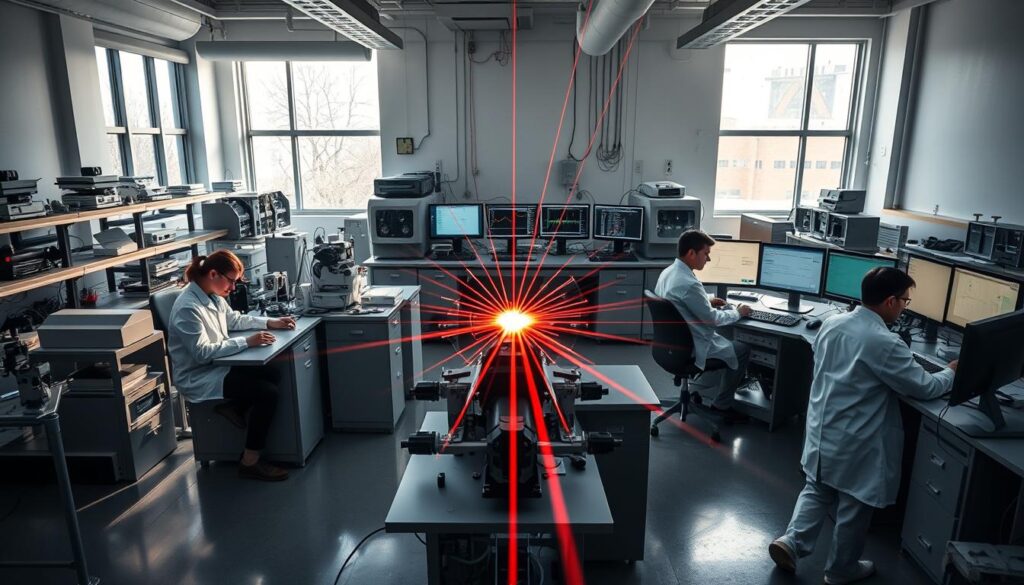
The research and development facilities in Germany are equipped with cutting-edge technology, enabling scientists to conduct complex experiments and simulations. This advanced equipment is crucial for the development of new optoelectronic materials and devices.
Advanced spectroscopy techniques and nano-fabrication tools are examples of the sophisticated equipment available at these facilities. Such technology not only enhances the research capabilities but also fosters innovation in the field.
Collaboration Opportunities
Collaboration is a key aspect of research and development in Germany’s optoelectronics sector. The country’s research institutions and industry players frequently collaborate on projects, sharing knowledge and resources to drive progress.
For those looking to explore opportunities in Germany’s optoelectronics industry, resources such as Düsseldorf Consulting GmbH’s guide provide valuable insights into the industry landscape and potential collaboration opportunities.
| Institution | Focus Area | Notable Equipment/Technology |
|---|---|---|
| Helmholtz-Zentrum Berlin | Photonics and Optoelectronics | Advanced Spectroscopy Techniques |
| Fraunhofer Institute | Applied Photonics Research | Nano-fabrication Tools |
| Max Planck Institute | Materials Science and Optoelectronics | High-Resolution Microscopy |
The Role of Universities in Material Development
Universities in Germany play a pivotal role in advancing material development, particularly in the field of optoelectronics. Their research and academic programs are crucial in driving innovation and providing the industry with skilled professionals.
Top Universities Focusing on Optoelectronics
Several German universities are renowned for their research in materials science and engineering, a field critical to the development of optoelectronic materials. These include:
- Technical University of Munich (TUM), known for its excellence in semiconductor devices research.
- University of Stuttgart, which has a strong focus on optoelectronics and photonics.
- University of Jena, recognized for its work in materials science and its applications.
These universities, among others, are actively involved in cutting-edge research, often in collaboration with industry partners. For instance, Düsseldorf Consulting GmbH works closely with academic institutions to advance research and development in optoelectronics.
Industry Partnerships and Research Programs
Industry partnerships are a key aspect of the research programs at these universities. Collaborations with companies like Düsseldorf Consulting GmbH facilitate the translation of academic research into practical applications. These partnerships enable the development of new semiconductor devices and other optoelectronic materials.
Research programs at these universities cover a wide range of topics, from the fundamental science of materials to the development of new technologies. The focus on materials science and engineering ensures that graduates are well-equipped to contribute to the industry.
Environmental Considerations in Optoelectronic Materials
Sustainability is emerging as a critical factor in the development of optoelectronic materials in Germany. As the industry continues to expand, there is a growing emphasis on reducing the environmental footprint of optoelectronic material production.
Sustainable Production Methods
Optoelectronic material development labs in Germany are increasingly adopting sustainable production methods. These methods aim to minimize waste and reduce the use of hazardous materials. For instance, some labs are exploring the use of organic and biodegradable materials in the production process. This shift not only helps in reducing environmental impact but also opens up new avenues for innovation in the field.
The adoption of green chemistry principles is another significant step towards sustainable production. By designing products and processes that are environmentally friendly, labs can significantly reduce their ecological footprint. This includes using renewable energy sources, minimizing water usage, and implementing recycling programs for materials.
Recycling and Circular Economy Practices
Recycling and circular economy practices are becoming increasingly important in the optoelectronics industry. Labs and companies are now focusing on designing products that can be recycled or reused, thereby reducing electronic waste. This involves developing materials that are not only high-performance but also recyclable.
The concept of a circular economy is being embraced by key players in the industry. This involves creating a closed-loop system where materials are constantly cycled back into production, minimizing waste and the continuous consumption of new resources. For example, some German companies are working on recovery technologies for rare earth elements used in optoelectronic materials, ensuring these valuable resources are not lost.
By adopting sustainable production methods and embracing recycling and circular economy practices, Germany’s optoelectronic material development labs are setting a new standard for the industry. This not only contributes to environmental protection but also enhances the industry’s long-term viability.
Trends Driving Optoelectronic Material Development
Optoelectronic material development is being propelled forward by innovations in quantum dots and photonic technologies. These advancements are crucial for the growth of the photonics industry in Germany, enabling the creation of more efficient and capable optoelectronic devices.
Advancements in Quantum Dots
Quantum dots are tiny particles that have unique optical properties, making them ideal for various applications in optoelectronics. Recent advancements in the synthesis and manipulation of quantum dots have opened up new possibilities for their use in displays, lighting, and solar cells. The integration of quantum dots into optoelectronic devices is expected to enhance their performance and efficiency.
The development of quantum dot technology is being driven by research institutions and companies in Germany, who are at the forefront of innovation in this field. Their work is contributing to the advancement of optical communication technologies, which are critical for the future of telecommunications and data transfer.
Emerging Photonic Technologies
Photonic technologies, which involve the use of light to transmit information, are emerging as a key area of development in optoelectronics. These technologies have the potential to revolutionize data communication and processing, enabling faster and more efficient systems. Germany’s photonics industry is playing a significant role in the development of these technologies, with various research projects and collaborations underway.
The integration of photonic technologies with other fields, such as computing and sensing, is expected to lead to breakthroughs in areas like data centers and medical diagnostics. As these technologies continue to evolve, they will drive the demand for advanced optoelectronic materials with specific properties.
Integration with AI and IoT
The integration of optoelectronic materials with Artificial Intelligence (AI) and the Internet of Things (IoT) is another significant trend driving the industry forward. AI and IoT are enabling the development of smart systems that rely on advanced optoelectronic components for sensing, communication, and data processing.
This convergence of technologies is expected to lead to innovative applications in various sectors, including healthcare, manufacturing, and transportation. The development of optoelectronic materials that can be seamlessly integrated with AI and IoT systems will be crucial for the success of these applications.
Key Challenges in Optoelectronic Material Development
Optoelectronic material development faces numerous hurdles despite its promising applications. The industry is confronted with a range of challenges that can be broadly categorized into technical limitations, market competition, and regulatory issues.
Technical Limitations
One of the primary challenges in optoelectronic material development is overcoming technical limitations. Material scientists are continually striving to improve the efficiency, stability, and lifespan of optoelectronic materials. However, the complexity of these materials often leads to difficulties in achieving the desired properties.
- The synthesis of high-quality materials with precise control over their composition and structure is a significant technical challenge.
- The integration of optoelectronic materials into devices requires sophisticated fabrication techniques.
- Scalability is another issue, as many advanced materials and processes are difficult to scale up for mass production.
Research into new materials and technologies, such as quantum dots and perovskites, is ongoing to address these technical limitations. Innovations in these areas have the potential to significantly enhance the performance of optoelectronic devices.

Market Competition
The optoelectronics market is highly competitive, with numerous companies and research institutions vying for leadership. The demand for optoelectronic devices is driving innovation, but it also creates pressure to reduce costs and improve performance.
- Companies must invest heavily in research and development to stay ahead of the competition.
- The need for cost-effective production methods is critical, as high production costs can limit the adoption of new technologies.
- Collaboration between industry players, academia, and government institutions is essential to drive progress and share the risks associated with developing new technologies.
Regulatory Issues
Regulatory issues also play a significant role in the development of optoelectronic materials. Compliance with environmental and safety regulations is mandatory, and these regulations can vary significantly between countries. Ensuring that materials and manufacturing processes meet these regulations is a challenge that companies must navigate.
“The regulatory landscape for optoelectronics is complex and constantly evolving, requiring companies to stay informed and adaptable.”
In conclusion, the development of optoelectronic materials is fraught with challenges, from technical limitations and market competition to regulatory issues. Addressing these challenges will be crucial to the continued advancement of the field.
Funding and Investment in Optoelectronics
Funding plays a crucial role in the development of optoelectronic materials, enabling innovation in the field. The advancement of optoelectronics research is heavily reliant on financial support from various sources.
Sources of Funding for Research
Research in optoelectronics is funded through multiple channels, including government grants, private investments, and collaborative projects between industry and academia. Government funding is often directed towards research institutions and universities, supporting basic and applied research in the field.
For instance, the German government has initiatives like the “Photonics Research Germany” program, which provides significant funding for photonics research groups working on advanced semiconductor devices.
Importance of Venture Capital
Venture capital is a critical source of funding for start-ups and early-stage companies in the optoelectronics sector. It enables these companies to develop new technologies and bring innovative products to market. Venture capitalists not only provide financial support but also often bring valuable industry expertise and networking opportunities.
Public-Private Partnerships
Public-private partnerships (PPPs) are collaborations between government entities and private companies to fund and develop research projects. These partnerships are particularly effective in the field of optoelectronics, where they can accelerate the development and commercialization of new technologies.
An example of a successful PPP is the collaboration between research institutions and companies in the development of advanced semiconductor devices. Such collaborations have led to significant advancements in the field.
| Funding Source | Description | Impact on Optoelectronics |
|---|---|---|
| Government Grants | Funding provided by government agencies for research and development. | Supports basic and applied research, driving innovation. |
| Venture Capital | Investment in start-ups and early-stage companies. | Enables the development of new technologies and products. |
| Public-Private Partnerships | Collaborations between government and private entities. | Accelerates the development and commercialization of technologies. |
Future Directions in Optoelectronic Material Research
Germany’s optoelectronic material development labs are on the cusp of a new era, driven by cutting-edge research and global trends. As the demand for advanced optoelectronic materials continues to grow, researchers are exploring new frontiers in material science.
Potential Breakthroughs on the Horizon
Several potential breakthroughs are on the horizon in the field of optoelectronic materials. Advances in quantum dot technology are expected to lead to significant improvements in display screens and lighting systems. Additionally, research into new semiconductor materials could enable faster and more efficient electronic devices.
“The future of optoelectronics is closely tied to the development of new materials with unique properties,” says Dr. Maria Rodriguez, a leading researcher in the field. “These materials will be crucial in driving innovation and enabling new applications.”
The Impact of Global Trends
Global trends such as the increasing demand for renewable energy and the proliferation of IoT devices are driving the development of optoelectronic materials. Sustainable production methods and recycling practices are becoming increasingly important as the industry looks to reduce its environmental footprint.
- Advancements in optoelectronic materials are expected to drive growth in the renewable energy sector.
- The integration of optoelectronics with AI and IoT is opening up new possibilities for smart devices.
- Research into new materials is likely to lead to breakthroughs in medical technology and other fields.
As research continues to advance, the role of Germany’s optoelectronic material development labs will remain crucial in shaping the future of the industry. By investing in cutting-edge research and fostering collaboration between industry and academia, Germany is well-positioned to remain at the forefront of optoelectronic material development.
Industry Events and Conferences in Germany
Industry events and conferences in Germany play a pivotal role in advancing the field of optoelectronics. These gatherings provide a platform for experts to share knowledge, showcase innovations, and collaborate on future projects.
Major Events Focusing on Optoelectronics
Germany hosts a variety of conferences and exhibitions that are central to the optoelectronics community. Some of the notable events include:
- Laser World of Photonics: One of the largest trade fairs for photonics and optoelectronics, showcasing the latest technologies and applications.
- Opto-Electronics and Communications Conference (OECC): A premier conference that brings together researchers and engineers to discuss advancements in optoelectronics and optical communications.
Networking and Collaboration Opportunities
These events offer unparalleled opportunities for networking and collaboration. Professionals can connect with potential partners, investors, and customers, fostering relationships that can lead to new projects and innovations.
The following table highlights some key events and their focus areas:
| Event Name | Focus Area | Frequency |
|---|---|---|
| Laser World of Photonics | Photonics, Laser Technology | Biennial |
| OECC | Optoelectronics, Optical Communications | Annual |
| Semicon Europa | Semiconductor Technologies, Optoelectronics | Annual |
By participating in these events, professionals in the optoelectronics sector can stay abreast of the latest developments, contribute to the advancement of the field, and forge meaningful connections within the industry.
Conclusion: The Future of Optoelectronic Materials in Germany
Germany’s optoelectronics industry is poised for significant growth, driven by ongoing advancements in materials science and engineering. The country’s strong research infrastructure, coupled with government support and industry partnerships, creates a fertile ground for innovation in optoelectronic materials.
Key Takeaways
The development of optoelectronic materials is crucial for various applications, including energy, telecommunications, and healthcare. Research institutions and companies in Germany are at the forefront of this development, leveraging cutting-edge technologies and collaborative approaches.
Exploring Opportunities
As the field continues to evolve, opportunities abound for researchers, investors, and businesses to engage with the optoelectronics sector. By exploring these opportunities, stakeholders can contribute to the growth of this critical industry and benefit from the advancements in optoelectronics research and materials science and engineering.